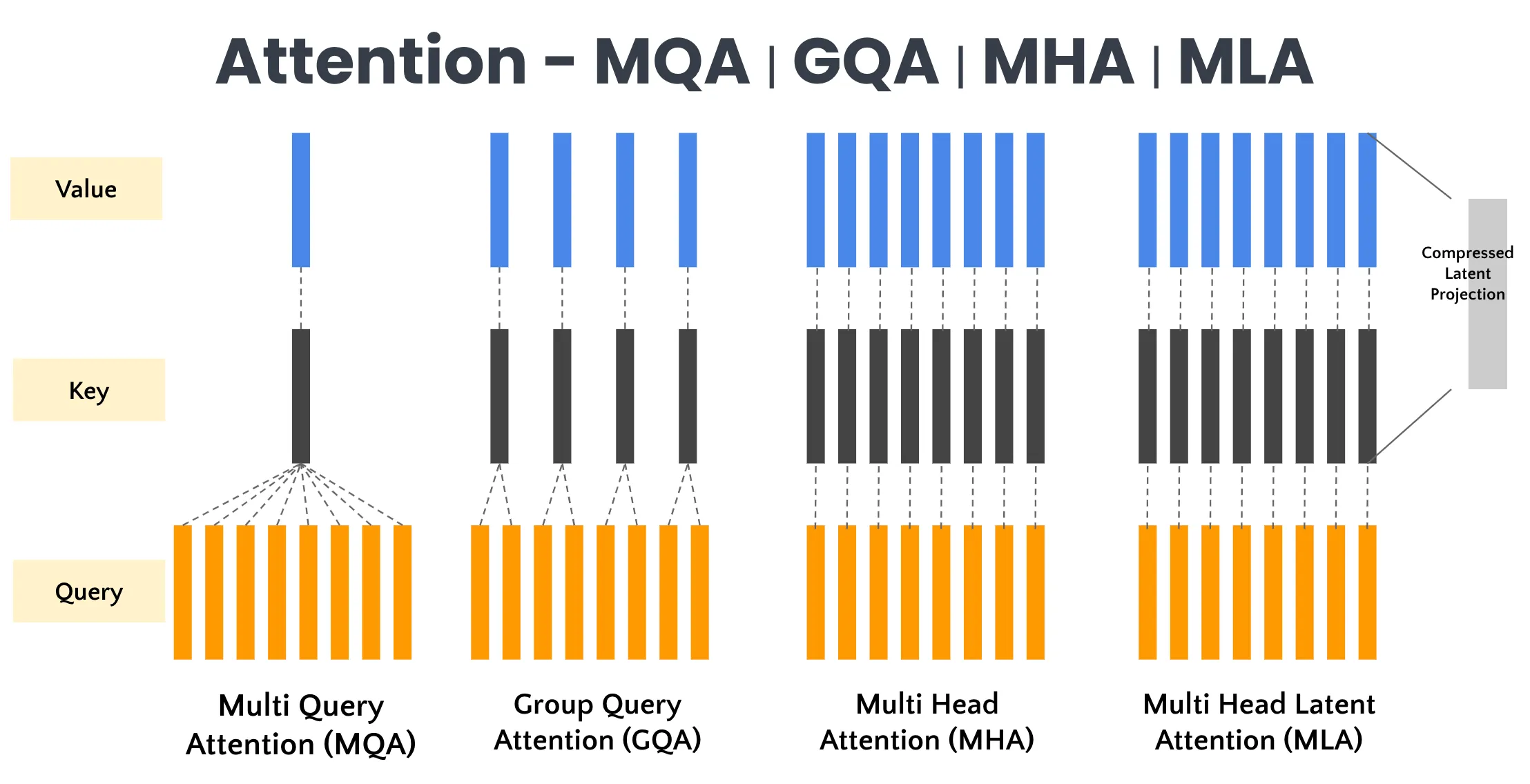
attention发展历程

大模型Attention发展历程

1

MHA Multi Head Attention

MHA 相比于传统的 Self-Attention 提升了模型的表达能力。例如一个专家组对比一个专家。
先看代码:

1
2
3
4
5
6
7
8
9
10
11
12
13
14
15
16
17
18
19
20
21
22
23
24
25
26
27
28
29
30
31
32
33
def forward(
self,
hidden_states: torch.Tensor,
position_embeddings: tuple[torch.Tensor, torch.Tensor],
attention_mask: Optional[torch.Tensor],
past_key_values: Optional[Cache] = None,
cache_position: Optional[torch.LongTensor] = None,
**kwargs: Unpack[TransformersKwargs],
) -> tuple[torch.Tensor, torch.Tensor]:
input_shape = hidden_states.shape[:-1]
hidden_shape = (*input_shape, -1, self.head_dim)

query_states = self.q_proj(hidden_states).view(hidden_shape).transpose(1, 2)
key_states = self.k_proj(hidden_states).view(hidden_shape).transpose(1, 2)
value_states = self.v_proj(hidden_states).view(hidden_shape).transpose(1, 2)

cos, sin = position_embeddings
query_states, key_states = apply_rotary_pos_emb(query_states, key_states, cos, sin)

attn_output, attn_weights = attention_interface(
self,
query_states,
key_states,
value_states,
attention_mask,
dropout=0.0 if not self.training else self.attention_dropout,
scaling=self.scaling,
**kwargs,
)

attn_output = attn_output.reshape(*input_shape, -1).contiguous()
attn_output = self.o_proj(attn_output)
return attn_output, attn_weights

这个 attention 是 Multi-head self-attention,注意力有头这个概念。其中,Q K V 这三个向量分别是由 hidden_states 乘上一个 Linear 层来计算的。这里面由于是多头注意力机制,所以需要让 Q K V 的 shape 变为 (batch, seq_len, num_head, head_dim)。之后 transpose 成 (batch, num_head, seq_len, head_dim),这么做的目的是为了让后续计算时,每个头可以独立进行注意力计算,让 num_head 变为“批次”的一部分,注意力仅在 seq_len 维度计算,而不把不同的 head 混在一起算。
再算完这几个向量后,需要对 Q K 向量添加位置信息,这就是 apply_rotary_pos_emb 的作用。之后就是 attention 的计算,也就是我们说的公式:

Attention(Q,K,V)=softmax(QKTdk)V\begin{aligned} \text{Attention}(Q, K, V) &= \text{softmax}\left(\frac{QK^T}{\sqrt{d_k}}\right)V \end{aligned}

其中,QK 的意思是 Q 和 K 的点积,表示 Q 和 K 之间的相似性,更进一步,这个向量是词向量,是词在高维空间的数值映射。词向量之间相关度高表示什么?是不是在一定程度上(不是完全)表示,在关注词 A 的时候,应当给予词 B 更多的关注?除以 dk\sqrt{d_k} 的作用是训练时防止梯度消失。
算完 attention 后,再被 o_projection 映射,结果就算出来了。

  • MHA (Multi-Head Attention):假设头个数为32,
    • 配置:每个 Query 头都有自己独立的 Key 头和 Value 头。
    • 数量:32 个 Q 头,对应 32 个 K 头 和 32 个 V 头。
    • 特点:完全独立,信息隔离性好,模型表达能力强。
      总结:MHA 多头自注意力机制是效果最好的也是最慢的,而 MQA 和 GQA 则是通过不同的方式来提升计算效率。
      一些比较出名的模型,如 LLama2-7B、LLama2-13B 使用的都是这种架构。

MQA Multi Query Attention

相比 MHA,MQA 允许一个 Query 头同时关注多个 Key 头和 Value 头,从而在保证信息隔离性的前提下,提升模型的计算效率。

  • MQA (Multi-Query Attention):假设头个数为32,
    • 配置:所有的 Query 头共享同一组 Key 和 Value 头。
    • 数量:32 个 Q 头,对应 1 个 K 头 和 1 个 V 头。
    • 特点:极端压缩,推理速度极快,但模型效果下降明显(因为所有头被迫看同样的 K/V 信息)。
      目前没听说哪个模型全程使用这个架构。但是 DeepSeek V3.2 的 decode 阶段使用了该方式。

GQA Group Query Attention

GQA 相比 MHA,其主要区别在于,GQA 是先进行“组内”注意力计算,再进行“组间”注意力计算。也就是说,GQA 首先将 Q K V 分成多组,然后在组内进行注意力计算,最后在组间进行注意力计算。推理速度更快,普遍用于 70B 及更大的模型中。MHA 则用于稍微小一点的模型中。

1
2
3
4
5
6
7
8
9
10
11
12
13
14
15
16
17
18
19
20
21
22
23
24
25
26
27
28
29
30
31
32
33
34
35
36
37
38
39
40
41
42
43
44
45
46
47
48
49
50
51
52
53
54
def forward(
self,
hidden_states: torch.Tensor,
attention_mask: Optional[torch.Tensor] = None,
position_ids: Optional[torch.LongTensor] = None,
past_key_values: Optional[Cache] = None,
output_attentions: bool = False,
use_cache: bool = False,
cache_position: Optional[torch.LongTensor] = None,
position_embeddings: Optional[tuple[torch.Tensor, torch.Tensor]] = None, # necessary, but kept here for BC
) -> tuple[torch.Tensor, Optional[torch.Tensor], Optional[tuple[torch.Tensor]]]:
bsz, q_len, _ = hidden_states.size()

query_states = self.q_proj(hidden_states)
key_states = self.k_proj(hidden_states)
value_states = self.v_proj(hidden_states)

query_states = query_states.view(bsz, q_len, -1, self.head_dim).transpose(1, 2)
key_states = key_states.view(bsz, q_len, -1, self.head_dim).transpose(1, 2)
value_states = value_states.view(bsz, q_len, -1, self.head_dim).transpose(1, 2)

cos, sin = position_embeddings
query_states, key_states = apply_rotary_pos_emb(query_states, key_states, cos, sin, position_ids)

# repeat k/v heads if n_kv_heads < n_heads
key_states = repeat_kv(key_states, self.num_key_value_groups)
value_states = repeat_kv(value_states, self.num_key_value_groups)

attn_weights = torch.matmul(query_states, key_states.transpose(2, 3)) / math.sqrt(self.head_dim)

if attention_mask is not None: # no matter the length, we just slice it
causal_mask = attention_mask[:, :, :, : key_states.shape[-2]]
attn_weights = attn_weights + causal_mask

# upcast attention to fp32
attn_weights = nn.functional.softmax(attn_weights, dim=-1, dtype=torch.float32).to(query_states.dtype)
attn_weights = nn.functional.dropout(attn_weights, p=self.attention_dropout, training=self.training)
attn_output = torch.matmul(attn_weights, value_states)

if attn_output.size() != (bsz, self.num_heads, q_len, self.head_dim):
raise ValueError(
f"`attn_output` should be of size {(bsz, self.num_heads, q_len, self.head_dim)}, but is"
f" {attn_output.size()}"
)

attn_output = attn_output.transpose(1, 2).contiguous()
attn_output = attn_output.reshape(bsz, q_len, self.hidden_size)

attn_output = self.o_proj(attn_output)

if not output_attentions:
attn_weights = None

return attn_output, attn_weights

可以看见代码里有一个 repeat_kv 的操作,作用是将较少的 Key/Value 头复制扩展,使它们能和 Query 的头数一一对应进行矩阵乘法。这正是 GQA 的典型操作:“分组共享,通过复制来对齐”。

  • GQA (Grouped Query Attention):
    • 配置:将 Query 头分组,每组 Query 头共享一组 Key 和 Value。
    • 数量:例如分为 8 组(Group=8)。32 个 Q 头,对应 8 个 K 头 和 8 个 V 头(每4个Q头共享1个K/V头)。
    • 特点:介于 MHA 和 MQA 之间。比 MQA 效果好(保留了部分独立性),比 MHA 速度快(KV Cache 大小减少了 4 倍)。
      GQA 相比于 MHA,效果上几乎相近,而速度却能达到 MQA 的水平,被广泛的应用在现在的大模型上。
      LLama2-70B、LLama3、Qwen2 全系列使用的都是这种架构。

MLA Multi Latent Attention

2

1
2
3
4
5
6
7
8
9
10
11
12
13
14
15
16
17
18
19
20
21
22
23
24
25
26
27
28
29
30
31
32
33
34
35
36
37
38
39
40
41
42
43
44
45
46
47
48
49
50
51
52
53
54
55
56
57
58
59
60
61
62
63
64
65
66
67
def forward(
self,
hidden_states: torch.Tensor,
position_embeddings: tuple[torch.Tensor, torch.Tensor],
attention_mask: Optional[torch.Tensor],
past_key_values: Optional[Cache] = None,
cache_position: Optional[torch.LongTensor] = None,
**kwargs: Unpack[FlashAttentionKwargs],
) -> tuple[torch.Tensor, Optional[torch.Tensor], Optional[tuple[torch.Tensor]]]:
batch_size, seq_length = hidden_states.shape[:-1]
query_shape = (batch_size, seq_length, -1, self.qk_head_dim)
key_shape = (batch_size, seq_length, -1, self.qk_nope_head_dim + self.v_head_dim)

if self.q_lora_rank is None:
q_states = self.q_proj(hidden_states)
else:
q_states = self.q_b_proj(self.q_a_layernorm(self.q_a_proj(hidden_states)))
q_states = q_states.view(query_shape).transpose(1, 2)
q_pass, q_rot = torch.split(q_states, [self.qk_nope_head_dim, self.qk_rope_head_dim], dim=-1)

compressed_kv = self.kv_a_proj_with_mqa(hidden_states)
k_pass, k_rot = torch.split(compressed_kv, [self.kv_lora_rank, self.qk_rope_head_dim], dim=-1)

k_pass = self.kv_b_proj(self.kv_a_layernorm(k_pass)).view(key_shape).transpose(1, 2)
k_pass, value_states = torch.split(k_pass, [self.qk_nope_head_dim, self.v_head_dim], dim=-1)

k_rot = k_rot.view(batch_size, 1, seq_length, self.qk_rope_head_dim)

cos, sin = position_embeddings
if self.config.rope_interleave: # support using interleaved weights for efficiency
q_rot, k_rot = apply_rotary_pos_emb_interleave(q_rot, k_rot, cos, sin)
else:
q_rot, k_rot = apply_rotary_pos_emb(q_rot, k_rot, cos, sin)
k_rot = k_rot.expand(*k_pass.shape[:-1], -1)

query_states = torch.cat((q_pass, q_rot), dim=-1)
key_states = torch.cat((k_pass, k_rot), dim=-1)

if past_key_values is not None:
# sin and cos are specific to RoPE models; cache_position needed for the static cache
cache_kwargs = {"sin": sin, "cos": cos, "cache_position": cache_position}
key_states, value_states = past_key_values.update(key_states, value_states, self.layer_idx, cache_kwargs)

if self.config._attn_implementation == "flash_attention_2" and self.qk_head_dim != self.v_head_dim:
value_states = F.pad(value_states, [0, self.qk_head_dim - self.v_head_dim])

attention_interface: Callable = eager_attention_forward
if self.config._attn_implementation != "eager":
attention_interface = ALL_ATTENTION_FUNCTIONS[self.config._attn_implementation]

attn_output, attn_weights = attention_interface(
self,
query_states,
key_states,
value_states,
attention_mask,
dropout=0.0 if not self.training else self.attention_dropout,
scaling=self.scaling,
**kwargs,
)

if self.config._attn_implementation == "flash_attention_2" and self.qk_head_dim != self.v_head_dim:
attn_output = attn_output[:, :, :, : self.v_head_dim]

attn_output = attn_output.reshape(batch_size, seq_length, -1).contiguous()
attn_output = self.o_proj(attn_output)
return attn_output, attn_weights

上面代码是 MLA 的流程。可以分为以下几步:

  1. Query 的生成与压缩
    DeepSeek 对 Q 进行了压缩,减少计算量
1
2
3
4
5
6
7
8
9
10
11
12
13
14
15
16
# 这一部分对应 Query 的生成
if self.q_lora_rank is None:
# 如果没有设置压缩秩,则使用标准投影
q_states = self.q_proj(hidden_states)
else:
# 【核心 MLA 特征】:Query 低秩压缩
# 1. q_a_proj: 降维 (hidden -> low_rank)
# 2. q_a_layernorm: 训练时加了个layernorm,防止梯度爆炸,归一化
# 3. q_b_proj: 升维 (low_rank -> num_heads * qk_head_dim)
q_states = self.q_b_proj(self.q_a_layernorm(self.q_a_proj(hidden_states)))

q_states = q_states.view(query_shape).transpose(1, 2)

# 【核心 MLA 特征】:解耦 RoPE
# 将 Query 分割为两部分:一部分不带位置信息,一部分带位置信息
q_pass, q_rot = torch.split(q_states, [self.qk_nope_head_dim, self.qk_rope_head_dim], dim=-1)
  1. KV 的压缩与潜在向量生成
1
2
3
4
5
6
7
8
9
# 【核心 MLA 特征】:KV 压缩
# 将输入投影到一个非常小的压缩向量 (Latent Vector)
# 这就是推理时缓存的 "KV Cache",体积非常小!
compressed_kv = self.kv_a_proj_with_mqa(hidden_states)

# 将压缩向量拆分:
# k_pass: 压缩后的 KV 内容特征 (用于后续还原)
# k_rot: 专门用于位置编码的部分
k_pass, k_rot = torch.split(compressed_kv, [self.kv_lora_rank, self.qk_rope_head_dim], dim=-1)
  1. KV 的解压与还原
1
2
3
4
5
6
# 1. 对压缩的内容特征进行 LayerNorm
# 2. kv_b_proj: 升维投影,将低维 Latent 还原成高维的 Key 和 Value
k_pass = self.kv_b_proj(self.kv_a_layernorm(k_pass)).view(key_shape).transpose(1, 2)

# 分离还原后的 Key 和 Value
k_pass, value_states = torch.split(k_pass, [self.qk_nope_head_dim, self.v_head_dim], dim=-1)

虽然我们在 Cache 里存的是压缩后的向量,但在计算当前时刻的 Attention 分数时,需要将其还原成完整的多头 Key 和 Value。虽然计算量增加了一些,但换来了显存带宽的大幅节省。

  1. 位置编码与拼接
1
2
3
4
5
6
7
8
9
10
# 对专门的位置部分应用 RoPE
cos, sin = position_embeddings
q_rot, k_rot = apply_rotary_pos_emb(q_rot, k_rot, cos, sin)

# 扩展 k_rot 维度以匹配多头

# 【核心 MLA 特征】:重组
# 将内容部分 和位置部分 拼接
query_states = torch.cat((q_pass, q_rot), dim=-1)
key_states = torch.cat((k_pass, k_rot), dim=-1)

最终参与计算的 query_states 和 key_states 是由“非旋转部分”和“旋转部分”拼接而成的。这样做的好处是,位置信息不会破坏压缩向量的低秩结构。为什么位置编码要这么做呢?因为在实现 MLA 的时候,有一个小技巧叫做“矩阵吸收”。

xWdownQWup,iQ(Wup,iK)T(cKV)Tx W_{down}^Q W_{up,i}^Q (W_{up,i}^K{})^T (c^{KV}{})^T

在这个公式中,可以将 kv 的上投影矩阵Wup,iKW_{up,i}^K看成是Wup,iQW_{up,i}^Q,这样子,位置信息部分就可以通过矩阵吸收的方式,被WdownQW_{down}^Q“吸收”进去了。但是如果加了常规旋转位置编码的话,位置信息部分就无法被WdownQW_{down}^Q“吸收”进去了。可以看见被隔断了。无法吸收,会导致推理效率下降。

xWdownQWup,iQRmRnT(Wup,iK)T(cKV)Tx W_{down}^Q W_{up,i}^Q R_{m} R_{n}^T (W_{up,i}^K{})^T (c^{KV}{})^T

所以引入了 Decoupled RoPE (解耦 RoPE)。q_rot 和 k_rot 分开处理,这样位置编码和内容编码就可以分开处理,互不干扰。

  1. 注意力计算
1
2
3
4
5
6
7
8
9
10
11
12
13
14
15
16
17
18
# 更新 KV Cache (这里存储的通常是还原后的 K 和 V,或者是压缩向量,取决于具体的 Cache 实现)
if past_key_values is not None:
key_states, value_states = past_key_values.update(...)

# 【Flash Attention 兼容性处理】
# 如果 QK 的维度和 V 的维度不一样,需要 Padding 对齐
if self.config._attn_implementation == "flash_attention_2" and self.qk_head_dim != self.v_head_dim:
value_states = F.pad(value_states, [0, self.qk_head_dim - self.v_head_dim])

# 调用标准注意力接口计算
attn_output, attn_weights = attention_interface(...)

# 去除 Padding
if ...:
attn_output = attn_output[:, :, :, : self.v_head_dim]

# 输出投影
attn_output = self.o_proj(attn_output)
  • MLA (Multi-Head Latent Attention)
    • 配置:通过生成 compressed_kv,将 KV Cache 的大小压缩了 90% 以上。存储上 compressed_kv 只有一份,接近 MQA。
    • 数量:通过 kv_b_proj 动态还原 KV,保留了多头注意力的表达能力。每个头一个 KV 数量,这一部分接近 MHA。
    • 特点:通过 split 和 cat 操作,把位置信息和内容信息分开处理,使得压缩机制能与 RoPE 完美兼容。

NSA Natural Sparse Attention

该注意力机制首次被提出是在 2025 年的 2 月。由 DeepSeek 针对长序列处理提出的原生稀疏注意力机制,属于 block-wise 的稀疏方案。这个目前只存在于论文中,没有实际用于某个模型。直到 Deepseek-V3.2 中,他们提出了 DSA,可以说是 NSA 的一个变种实现, 属于 token-wise 的稀疏方案。

  1. 压缩块,计算块间注意力
    标准自注意力需要计算序列中每个词元(Token)与其他所有词元的关系。对于一个长度为 N 的序列,需要计算 N*N 个注意力权重,随长度二次增长。
    解决方案是,NSA 不再以单个 token 为基本计算单元,而是将连续的多个 token 聚合成一个 block。例如,将 4096 个词元的序列划分为 64 个块,每个块包含 64 个 token。
    计算流程转变:
    之前(标准注意力): 处理 4096 个 token -> 需要处理 4096 * 4096≈16.7M 个关系对。
    之后(块压缩): 处理 64 个 block -> 先计算块与块之间的注意力。此时,需要处理的关系对数量骤降至 64 * 64=4096 个。
  2. 重要性筛选:选出重要的 K 个块
    在压缩后的 block 中,筛选出需要详细看的部分:
    块压缩是假设所有 block 都同等重要。但实际上,对于当前要处理的 token 来说,某些 block 是关键的而其他的是次要的。NSA 引入动态机制,根据当前的 Q 内容,评估并筛选出最相关的少量关键 block。
    系统会为每个 block 计算一个“重要性分数”。这个分数通常基于当前 Q 与每个 block 的“摘要向量”(通常是 block 内 token 的均值或通过一个小型网络生成)的相似度。
    在块压缩的基础上增加重要性筛选,系统从64个块中选出最相关的 K 个块(例如 K=8),额外计算当前查询向量与这 K 个关键块内全部 token 的注意力。
  3. 滑动窗口
    为了保证局部上下文信息的完整性,token 不但要关注遥远的关键块,还要关注紧挨着它的其他 token。NSA 强制性地规定,无论重要性筛选的结果如何,每个 token 都必须关注以其自身为中心的一个局部窗口内的所有其他token。这个窗口是“滑动”的,因为它随着 token 位置的变化而移动。例如,假设滑动窗口大小为 256。那么对于序列中第 500 个 token,无论如何它都会关注第 500-255 至第 500 这个范围内的所有 token。

DSA DeepSeek Sparse Attention

DSA 首次被应用在 Deepseek V3.2 Exp 中,属于 token-wise 的稀疏方案。DeepSeek-V3.2-Exp 仅在 DeepSeek-V3 的基础上新增了 Lightning Indexer 模块,用于选择参与 attention 的 token。
该模块的主要输入是 compressed_q 与 MLA 的输入矩阵 hidden_states,输出则是每个 token 所对应的 2048 个可参与 attention 计算的历史 token 的 index。
被选中的 2048 个 token 会在 attention 的 mask 阶段发挥作用:通过将未选中的位置的 mask 值设为 inf,在经过 softmax 之后,就能有效去除不需要参与 attention 的 token。这样实现了高效的稀疏化,显著降低了计算量。从O(L^2)降到了O(LK),其中 K<<L 为 2048。
Indexer 代码(来自于官方 DeepSeek V3.2 仓库):

1
2
3
4
5
6
7
8
9
10
11
12
13
14
15
16
17
18
19
20
21
22
23
24
25
26
27
28
29
30
31
32
33
34
35
36
37
38
39
40
41
42
43
44
45
46
47
48
49
50
51
52
53
54
55
56
57
58
59
60
61
62
63
64
65
66
67
68
69
70
71
72
73
74
def fp8_index(
q: torch.Tensor,
q_s: torch.Tensor,
k: torch.Tensor,
k_s: torch.Tensor,
) -> torch.Tensor:
"""
Perform index score using FP8 precision.

Args:
q (torch.Tensor): The Q tensor, must be contiguous.
q_s (torch.Tensor): The scaling factor for Q (float), must be contiguous.
k (torch.Tensor): The K tensor, must be contiguous.
k_s (torch.Tensor): The scaling factor for K (e8m0 here), must be contiguous.

fp8 q @ fp8 k -> fp32 logits
relu(fp32 logits) * q_s (weights) -> fp32 logits
fp32 logits -> fp32 logits_sum
fp32 logits_sum * k_s (e8m0) -> fp32 index_score
"""
return fp8_index_kernel(q.shape[2], q.shape[3])(q, q_s, k, k_s)

class Indexer(torch.nn.Module):
def __init__(self, args: ModelArgs):
super().__init__()
self.dim: int = args.dim
self.n_heads: int = args.index_n_heads
self.n_local_heads = args.index_n_heads // world_size
self.head_dim: int = args.index_head_dim
self.rope_head_dim: int = args.qk_rope_head_dim
self.index_topk: int = args.index_topk
self.q_lora_rank: int = args.q_lora_rank
self.wq_b = Linear(self.q_lora_rank, self.n_heads * self.head_dim)
self.wk = Linear(self.dim, self.head_dim)
self.k_norm = LayerNorm(self.head_dim)
# weights_proj in the checkpoint is stored in bf16, while the parameters here are stored in fp32 for convenient.
self.weights_proj = Linear(self.dim, self.n_heads, dtype=torch.float32)
self.softmax_scale = self.head_dim ** -0.5
self.scale_fmt = args.scale_fmt

self.register_buffer("k_cache", torch.zeros(args.max_batch_size, args.max_seq_len, self.head_dim, dtype=torch.float8_e4m3fn), persistent=False)
self.register_buffer("k_scale_cache", torch.zeros(args.max_batch_size, args.max_seq_len, self.head_dim // block_size, dtype=torch.float32), persistent=False)

def forward(self, x: torch.Tensor, qr: torch.Tensor, start_pos: int, freqs_cis: torch.Tensor, mask: Optional[torch.Tensor]):
bsz, seqlen, _ = x.size()
end_pos = start_pos + seqlen
q = self.wq_b(qr)
q = q.view(bsz, seqlen, self.n_heads, self.head_dim)
q_pe, q_nope = torch.split(q, [self.rope_head_dim, self.head_dim - self.rope_head_dim], dim=-1)
# rope in indexer is not interleaved
q_pe = apply_rotary_emb(q_pe, freqs_cis, False)
q = torch.cat([q_pe, q_nope], dim=-1)
k = self.wk(x)
k = self.k_norm(k)
k_pe, k_nope = torch.split(k, [self.rope_head_dim, self.head_dim - self.rope_head_dim], dim=-1)
# rope in indexer is not interleaved
k_pe = apply_rotary_emb(k_pe.unsqueeze(2), freqs_cis, False).squeeze(2)
k = torch.cat([k_pe, k_nope], dim=-1)
q = rotate_activation(q)
k = rotate_activation(k)
q_fp8, q_scale = act_quant(q, block_size, self.scale_fmt)
k_fp8, k_scale = act_quant(k, block_size, self.scale_fmt)
self.k_cache[:bsz, start_pos:end_pos] = k_fp8
self.k_scale_cache[:bsz, start_pos:end_pos] = k_scale
weights = self.weights_proj(x.float()) * self.n_heads ** -0.5
weights = weights.unsqueeze(-1) * q_scale * self.softmax_scale
index_score = fp8_index(q_fp8.contiguous(), weights, self.k_cache[:bsz, :end_pos].contiguous(), self.k_scale_cache[:bsz, :end_pos].contiguous())
if mask is not None:
index_score += mask
topk_indices = index_score.topk(min(self.index_topk, end_pos), dim=-1)[1]
topk_indices_ = topk_indices.clone()
dist.broadcast(topk_indices_, src=0)
assert torch.all(topk_indices == topk_indices_), f"{topk_indices=} {topk_indices_=}"
return topk_indices

公式如下:

It,s=j=1HIwt,jIReLU(qt,jIksI)I_{t,s} = \sum_{j=1}^{H_{I}} w_{t,j}^{I} \cdot \operatorname{ReLU}\left( \boldsymbol{q}_{t,j}^{I} \cdot \boldsymbol{k}_{s}^{I} \right)

总体框架如下:
3
其中,绿色部分是 indexer 实现。而框住的部分是函数 fp8_index 部分。可以看到,虽然说 attention 的计算复杂度降低了,但是实际上选择不同 token 重要性这个 indexer 模块,也算是个 attention。还是需要计算查询相对于之前每个 token 的 attention 的重要性分数,复杂度还是 O(n2)O(n^2)。只不过这个过程是在 fp8 精度下进行的,所以效率会比较高。

为什么需要哈达玛变换"rotate_activation"?
直接量化 q 和 k 向量可能会造成精度损失。引入旋转变换操作:将大范围数值打散到小范围。可以与随机的正交矩阵相乘来做这件事,使得向量数值分布均匀且模长不变。不过矩阵乘法代价较大。于是使用小代价的哈达玛变换。

最后得出的topk_indices,会作为 mask 输入到 MLA 中,从而实现稀疏化。可以看下面代码。
对于 Deepseek V3.2 的 attention 实现而言:

1
2
3
4
5
6
7
8
9
10
11
12
13
14
15
16
17
18
19
20
21
22
23
24
25
26
27
28
29
30
31
32
33
34
35
36
37
38
39
40
41
42
43
44
45
46
47
48
49
50
51
52
53
54
55
56
57
58
59
60
61
62
63
64
def forward(self, x: torch.Tensor, start_pos: int, freqs_cis: torch.Tensor, mask: Optional[torch.Tensor]):
"""
Forward pass for the Multi-Head Latent Attention (MLA) Layer.

Args:
x (torch.Tensor): Input tensor of shape (batch_size, seq_len, dim).
start_pos (int): Starting position in the sequence for caching.
freqs_cis (torch.Tensor): Precomputed complex exponential values for rotary embeddings.
mask (Optional[torch.Tensor]): Mask tensor to exclude certain positions from attention.

Returns:
torch.Tensor: Output tensor with the same shape as the input.
"""
bsz, seqlen, _ = x.size()
end_pos = start_pos + seqlen
qr = self.q_norm(self.wq_a(x))
q = self.wq_b(qr)
q = q.view(bsz, seqlen, self.n_local_heads, self.qk_head_dim)
q_nope, q_pe = torch.split(q, [self.qk_nope_head_dim, self.qk_rope_head_dim], dim=-1)
q_pe = apply_rotary_emb(q_pe, freqs_cis)
kv = self.wkv_a(x)
kv, k_pe = torch.split(kv, [self.kv_lora_rank, self.qk_rope_head_dim], dim=-1)
kv = self.kv_norm(kv)
k_pe = apply_rotary_emb(k_pe.unsqueeze(2), freqs_cis)
# we use fp8 kv cache in actual deployment, so here we simulate the precision by casting kv to fp8 and then back to bf16.
kv_fp8, kv_scale = act_quant(kv, block_size, self.scale_fmt)
kv = (kv_fp8.view(-1, block_size).float() * kv_scale.view(-1, 1)).to(kv.dtype).view_as(kv)
self.kv_cache[:bsz, start_pos:end_pos] = kv
self.pe_cache[:bsz, start_pos:end_pos] = k_pe.squeeze(2)
if mask is not None: # MHA prefill
q = torch.cat([q_nope, q_pe], dim=-1)
kv = self.wkv_b(kv)
kv = kv.view(bsz, seqlen, self.n_local_heads, self.qk_nope_head_dim + self.v_head_dim)
k_nope, v = torch.split(kv, [self.qk_nope_head_dim, self.v_head_dim], dim=-1)
k = torch.cat([k_nope, k_pe.expand(-1, -1, self.n_local_heads, -1)], dim=-1)
scores = torch.einsum("bshd,bthd->bsht", q, k).mul_(self.softmax_scale)

# indexer
topk_indices = self.indexer(x, qr, start_pos, freqs_cis, mask)
index_mask = torch.full((bsz, seqlen, seqlen), float("-inf"), device=x.device).scatter_(-1, topk_indices, 0)
index_mask += mask
scores += index_mask.unsqueeze(2)

scores = scores.softmax(dim=-1)
x = torch.einsum("bsht,bthd->bshd", scores, v)
else: # MQA decode
if self.dequant_wkv_b is None and self.wkv_b.scale is not None:
self.dequant_wkv_b = weight_dequant(self.wkv_b.weight, self.wkv_b.scale)
wkv_b = self.wkv_b.weight if self.dequant_wkv_b is None else self.dequant_wkv_b
wkv_b = wkv_b.view(self.n_local_heads, -1, self.kv_lora_rank)
q_nope = torch.einsum("bshd,hdc->bshc", q_nope, wkv_b[:, :self.qk_nope_head_dim])
scores = (torch.einsum("bshc,btc->bsht", q_nope, self.kv_cache[:bsz, :end_pos]) +
torch.einsum("bshr,btr->bsht", q_pe, self.pe_cache[:bsz, :end_pos])) * self.softmax_scale

# indexer
topk_indices = self.indexer(x, qr, start_pos, freqs_cis, mask)
index_mask = torch.full((bsz, 1, end_pos), float("-inf"), device=x.device).scatter_(-1, topk_indices, 0)
scores += index_mask.unsqueeze(2)

scores = scores.softmax(dim=-1)
x = torch.einsum("bsht,btc->bshc", scores, self.kv_cache[:bsz, :end_pos])
x = torch.einsum("bshc,hdc->bshd", x, wkv_b[:, -self.v_head_dim:])
x = self.wo(x.flatten(2))
return x